

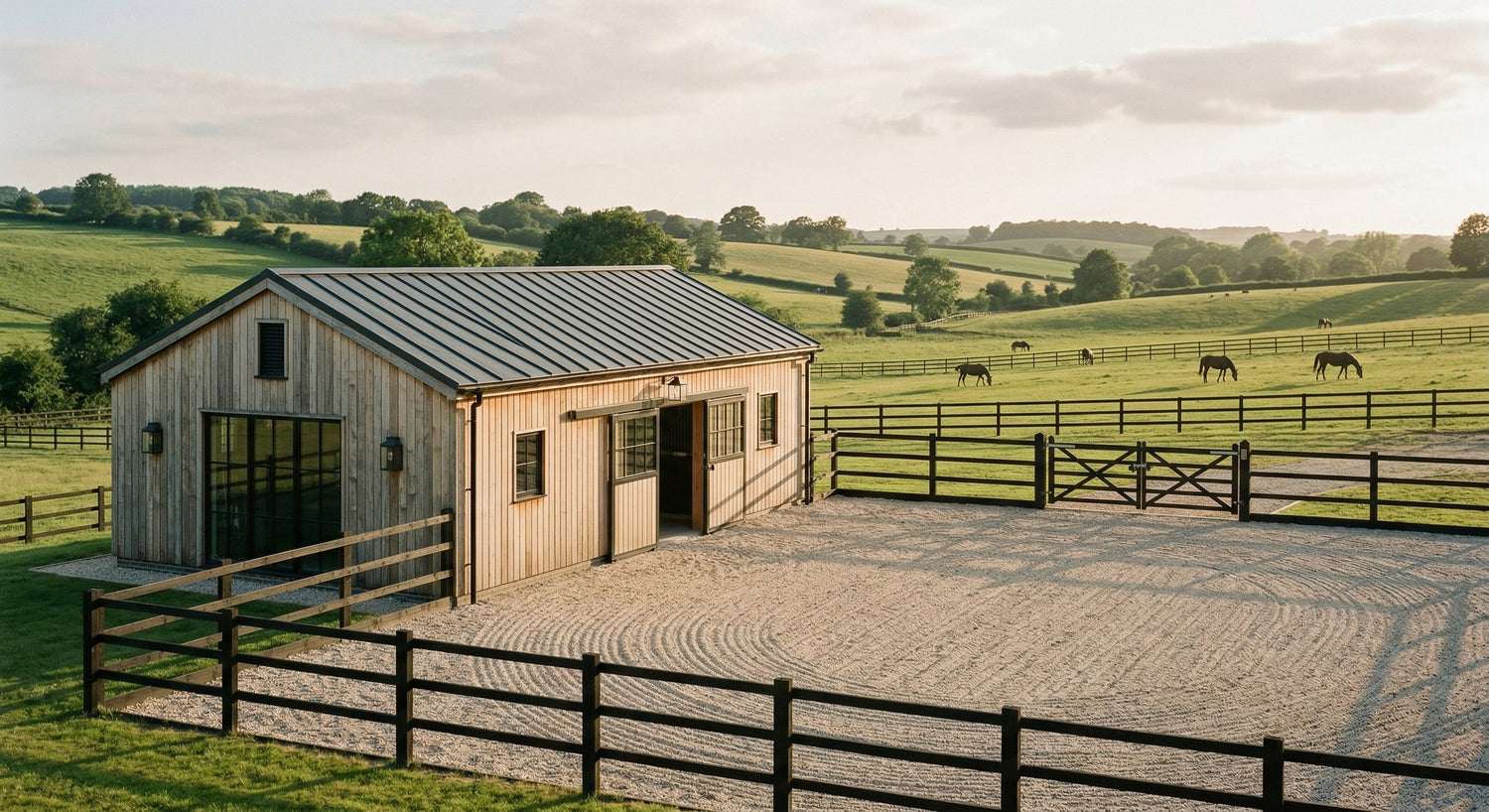
If you've ever watched your pastures turn from green to brown mush over a single winter — or spent a spring wondering whether the grass would ever come back — you've experienced the problem that a sacrifice area is designed to solve.
A sacrifice area is one of the most effective tools available to horse property owners, and it's recommended by virtually every agricultural university, cooperative extension office, and conservation district in the country. Yet many horse owners either haven't heard the term or have tried to create one and watched it turn into the muddiest spot on the property.
This guide covers what a sacrifice area actually is, why it matters, how to size and place one, what to do about footing, and where to go for help. Whether you call it a dry lot, a winter paddock, a heavy use area, or just "the paddock," the principles are the same — and the benefits to your land, your pastures, and your horses are significant.
What Is a Sacrifice Area?
A sacrifice area is a relatively small, non-grazable outdoor space where horses are kept when they need to be off the pasture. The term comes from the idea that you are intentionally "sacrificing" that piece of land — accepting that grass won't grow there — in order to protect the rest of your property.
The concept was developed and popularized by conservation districts and the USDA Natural Resources Conservation Service (NRCS) as a best management practice for livestock operations. It's not a workaround or a temporary fix. It's a foundational element of responsible horse property design.
You'll see sacrifice areas referred to by several names depending on the region and the source:
- Dry lot — the most common term among horse owners
- Winter paddock — used regionally, especially in the Pacific Northwest and Northeast
- Heavy use area (HUA) — the technical term used by conservation agencies and extension services
- Sacrifice paddock or sacrifice lot — the original conservation district terminology
- Confinement area or holding area — used by some extension publications
Regardless of what you call it, the purpose is the same: keep horses off vulnerable pasture during periods when hoof traffic would cause lasting damage.
Why Sacrifice Areas Matter: The Case for Protecting Your Pastures
Horses are uniquely hard on pastures compared to other livestock. According to Penn State Extension, horses are selective grazers that eat their preferred forage species very close to the ground while leaving other areas untouched. They graze for 10 to 14 hours per day — far longer than cattle, which alternate between eating and resting. And their hooves, which concentrate significant weight on a small surface area, compact soil and destroy root systems when the ground is wet.
The result of unrestricted winter or wet-season turnout on pasture is a cascading set of problems:
Soil compaction. Wet soil that is repeatedly compressed by hooves loses its structure. Water can no longer infiltrate the ground, which leads to pooling, runoff, and more mud. Once soil is compacted, it can take years to recover even with active management.
Root system destruction. When horses graze dormant or stressed grass down to the soil surface, they remove the plant's ability to photosynthesize and rebuild its root reserves. Grass that's overgrazed in fall or winter often doesn't come back the following spring — or it comes back so weakly that weeds take over.
Weed invasion. Bare, compacted soil with no healthy grass is an invitation for weeds. The Maryland Department of Agriculture notes that if a sacrifice lot grows beyond one acre without active management, it essentially becomes an unmanaged overgrazed pasture that will be overrun with weeds.
Environmental impact. Mud and manure from overgrazed pastures create nutrient-rich runoff that can contaminate streams, ponds, and groundwater. Many counties and conservation districts actively promote sacrifice areas as a water quality protection measure.
Increased costs. Damaged pastures require expensive renovation — reseeding, fertilizing, and potentially years of rest before they're productive again. Meanwhile, if you use your pastures for nutrition, you're buying more hay to compensate for forage you no longer have. Even if you feed hay along with pasture, an unhealthy pasture creates greater risks for your horses such as inviting toxic weeds or causing excess consumption of particulates from the soil while grazing.
The Iowa State University Extension summarizes the benefits of a well-designed sacrifice area: a space where horses can get out of the mud, healthy pastures, the ability to implement rotational grazing, easier manure removal, and improved property value.
When to Use a Sacrifice Area
A sacrifice area isn't just for "mud season." There are several situations throughout the year when confining horses to a designated space protects both your land and your animals.
Winter and Wet Season
This is the primary use case. When grass is dormant, it cannot recover from hoof traffic. Horses kept on pasture during winter months compact wet soil, destroy grass crowns, and create conditions that prevent healthy spring regrowth. University of Minnesota Extension recommends confining horses to a sacrifice paddock and feeding hay whenever pastures are too wet, don't have enough leaf matter, or are resting. The Snohomish Conservation District recommends horses be kept in confinement areas throughout the rainiest months — generally October through March.
Any Time Grass Is Grazed Below 3 Inches
This is the rule that catches most horse owners by surprise — and it applies year-round, not just in winter.
When grass is grazed below approximately 3 inches in height, the root systems begin to die. Without healthy roots, grass can't regrow. What you get instead is bare soil: dusty in summer, mud in winter, and wide open for weed invasion in every season.
The Snohomish Conservation District's Confinement Areas for Horses fact sheet states it clearly: during the growing season, horses should be moved to a new pasture or a confinement area whenever grass is 3 inches or less in height, and should not be returned to the pasture until grass has regrown to 6–8 inches. This is consistent with guidance from University of Minnesota Extension, which advises keeping horses off pastures until grass reaches 6 to 8 inches in spring and removing them when forage is grazed down to 3 to 4 inches.
This means your sacrifice area isn't just a winter tool — it's a summer pasture management tool too. Any time your rotational paddocks are grazed down, the sacrifice area is where horses can go while the grass recovers.
Spring Grass Transition
Turning horses out too early in spring — before grass reaches at least 6 inches of new growth — can set your pastures back for the entire season. A sacrifice area gives you a holding space while the grass establishes. This also helps you transition horses gradually onto spring grass, reducing the risk of colic or laminitis from sudden dietary changes.
Metabolic Horse Management
For horses with Equine Metabolic Syndrome (EMS), Pituitary Pars Intermedia Dysfunction (PPID/Cushing's), or a history of laminitis, unrestricted access to lush pasture — particularly during spring and fall sugar surges — can be dangerous. A grass-free sacrifice area provides a safe, controlled environment where these horses can live outdoors without the dietary risk.
Rotational Grazing Rest Periods
If you practice rotational grazing — and every major extension service recommends that you do — you need somewhere to put the horses when all paddocks need rest. A sacrifice area is the central hub of any rotational system.
Drought Conditions
During prolonged dry spells, grass growth slows or stops entirely. Continued grazing during drought can permanently damage pastures. A sacrifice area protects your forage investment during these periods.
Pasture Maintenance
Mowing, dragging, overseeding, fertilizing, herbicide application — all of these routine maintenance tasks require keeping horses off the pasture for days or weeks. A sacrifice area makes this possible without stalling your horses.
How to Choose the Right Location
Placement is one of the most important decisions you'll make. A poorly sited sacrifice area can create drainage problems, environmental contamination, or simply more mud than the space it was supposed to replace.
Here's what the research recommends:
Choose High Ground
The Northern Virginia Soil and Water Conservation District recommends locating sacrifice areas on higher ground with a slight slope of 1–2 percent for drainage. Avoid low-lying areas, natural drainage channels, and floodplains — these will accumulate water and create chronic mud problems.
Face South or East
South- and east-facing sites receive more sunlight and dry out faster. The Maryland Department of Agriculture specifically advises against north-facing locations, which tend to stay shaded and damp.
Keep It Close to the Barn
For daily chore efficiency, the sacrifice area should be adjacent to (or easily accessible from) your barn, manure storage, and feeding areas. The UConn Extension notes that close proximity to the barn makes manure removal — the single most important maintenance task — far more practical.
Connect to Pastures via Gates or Laneways
The best farm layouts position the sacrifice area so that horses can access their pastures through gates when turnout conditions are appropriate. University of Minnesota Extension recommends using laneways and gates to provide access to dry lot waterers from the pastures, creating a seamless flow between areas.
Buffer from Water Sources
Sacrifice areas should be located as far as possible from streams, ponds, wetlands, and wells. Surround the area with a vegetated buffer strip — a thick stand of grass that filters sediment and nutrients from any runoff. Horses for Clean Water, a nationally recognized horse property education program, recommends a 25-foot-wide vegetative buffer surrounding sacrifice areas.
Divert Roof Runoff
If there's a run-in shed or barn adjacent to the sacrifice area, all roof runoff should be captured with gutters and downspouts and routed away from the space. The Northwest Horse Source reports that a simple two-stall run-in shed in an area receiving 39 inches of annual rainfall sheds over 8,000 gallons of water per year. That water going directly into your sacrifice area will wreak havoc on any footing investment you've made.
How Big Should a Sacrifice Area Be?
Sizing recommendations vary by source, but the general principle is the same: big enough for comfort and safety, small enough to manage effectively.
Minimum Size per Horse
| Source | Minimum Recommendation |
|---|---|
| Midwest Plan Service Horse Facilities Handbook | 1,000 sq ft per horse |
| Penn State Extension | 1,200 sq ft for individual turnout; 600 sq ft per horse in group setting |
| University of Minnesota Extension | 400 sq ft per horse (minimum) |
| Northern Virginia SWCD | As small as 14' x 24' for one horse |
| UMass Amherst | 200 sq ft per horse (exercise minimum) |
| Snohomish Conservation District | 750–1,000 sq ft per horse; long/narrow for active horses |
Practical Sizing Guidance
For a single horse in a stall-run configuration, a width of 12 feet with a length of 50–60 feet provides some minimal freedom of movement. This is common on properties where each horse has an individual run attached to a stall or shelter. The Snohomish Conservation District recommends 750–1,000 square feet per horse and notes that energetic horses benefit from long, narrow configurations (such as 20' wide by 100' long) that encourage movement and reduce boredom.
For multiple horses sharing a sacrifice area, plan for at least 60' x 60' (3,600 sq ft) for two to three horses. Increase the size proportionally for larger groups, and consider herd dynamics — you need enough space that a lower-ranking horse can move away from a dominant herd mate without being cornered.
Don't Go Too Big
Bigger isn't always better. A sacrifice area larger than one acre becomes difficult to maintain, expensive to install footing on, and hard to keep grass-free if you're using the space for metabolic horse management. The Maryland Department of Agriculture warns that oversized sacrifice lots essentially become unmanaged overgrazed pastures.
The ideal approach is to keep the sacrifice area as small as practical for the number of horses using it, and put those saved dollars toward better footing.
The Footing Challenge: How Sacrifice Areas Turn into Mud Pits
This is where most sacrifice areas run into trouble.
The concept is simple. The execution gets complicated because of one unavoidable reality: a smaller area with concentrated hoof traffic and no grass generates more mud per square foot than any other space on your property.
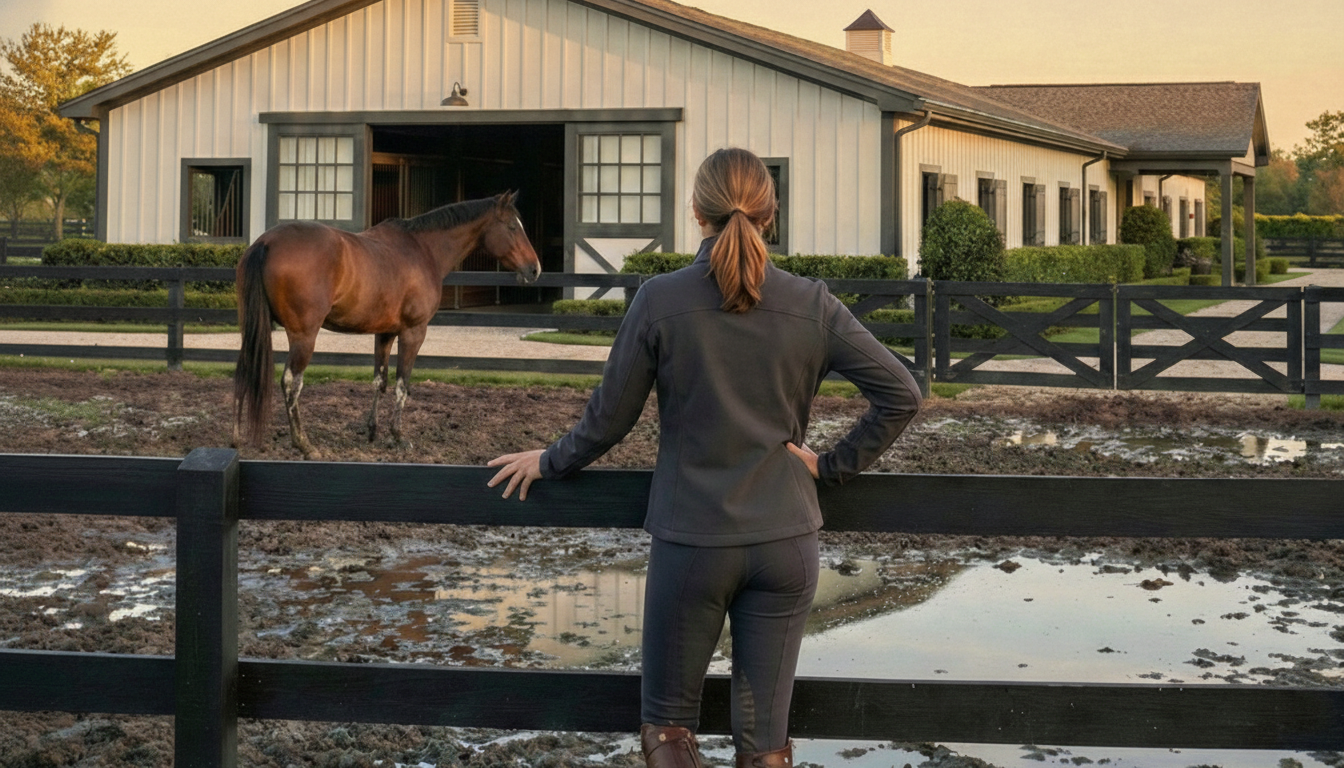
Bare soil — even well-drained soil on high ground — cannot withstand the pounding that hooves deliver in a confined space during wet months. The soil compacts, loses its ability to drain, and saturates. The horse churns the saturated soil into mud. Manure and urine accelerate the breakdown. And now the space that was supposed to protect your pastures is now the worst spot on the farm and you don't want to put your horses out in it.
Temporary Footing Materials
Horse owners typically try one or more of these before arriving at a long-term solution:
Wood chips or hog fuel — Inexpensive and initially comfortable for horses, but wood products decompose quickly in wet environments. They absorb moisture, become a breeding ground for bacteria and fungi (which can affect hooves), turn slippery when frozen, and need to be replaced every one to two seasons. UMass Amherst notes that wood chips will need periodic replacement as they mix with the underlying soil.
Sand — Drains well and is comfortable for horses to lie on, but carries a risk of sand colic if horses ingest it while eating off the ground. Sand also migrates easily, creating uneven surfaces with high and low spots where water collects.
Loose gravel without stabilization — Crushed gravel is the most durable footing material available for sacrifice areas, and it's what most extension services recommend. However, without some form of stabilization, gravel requires a significant depth to remain functional. Penn State Extension specifies a minimum 6-inch compacted support layer of coarse aggregate, topped with a 2-inch cushion layer of finer material — 8 or more inches total. Experienced horse owners in wetter climates report needing 6 to 18 inches of gravel base depending on their soil type and drainage conditions. Even at these depths, unstabilized gravel on soft or clay-heavy ground can shift laterally under hoof traffic and slowly sink into the soil below.
The Role of Geotextile Fabric
A layer of non-woven geotextile fabric between the native soil and your footing is a great tool. This fabric serves as a separation layer — it prevents footing material from migrating into the mud below and prevents soil from working its way up into your gravel. Iowa State Extension and virtually every other extension source recommends geotextile as a foundational component.
Without fabric, gravel placed directly on soil will disappear into the mud within one to two seasons, requiring you to start over. However, the fabric can cause more trouble than good if the layer of gravel over the top is too thin or not properly constructed to be a solid base. Once it starts to come up through the ground it's hazardous, cumbersome, and very difficult to remove.
Geocell Stabilization: A Better Approach
The most effective long-term solution for sacrifice area footing is a combination of geotextile fabric and a geocell grid system filled with angular crushed gravel. Geocell panels are flexible, three-dimensional grid structures that hold gravel in individual cells, preventing the lateral movement that causes unstabilized gravel to shift, spread, and lose its structure under hoof traffic.
This approach dramatically reduces the depth of gravel required — typically to just 3–4 inches — because the cells confine the material and distribute the load. It also eliminates the need for excavation, base preparation, or heavy equipment, making it accessible as a DIY project for most horse property owners.
Lighthoof panels are a geocell system designed specifically for equine use. Each panel is 6 feet wide by 12 feet long, with 3-inch deep cells that hold angular crushed gravel in place permanently. To install, you roll out geotextile fabric over your existing ground, stretch the panels over the fabric, and fill with gravel. There's no excavation, no base layer, and no heavy equipment required.
Sacrifice Area Maintenance
A well-built sacrifice area is low-maintenance, but it's not no-maintenance. Here are the key ongoing tasks:
Daily Manure Removal
This is the single most important maintenance task. UConn Extension explains that manure and wasted feed left on the surface get churned into the footing, increase the water-holding capacity of the ground, and create more mud. The Northern Virginia SWCD recommends removing manure daily, and always before a rain or snow event.
Seasonal Inspection and Top-Dressing
Check your footing at least twice a year — before the wet season and after it. Look for smushy spots, areas where gravel has thinned, and any places where the tops of your Lighthoof cells may have become exposed. Add fresh gravel as needed. With a stabilized system, this is minimal. Without one, plan to add material more frequently.
Annual Gutter and Drainage Maintenance
Clean gutters on adjacent structures and inspect downspout routing to make sure roof runoff is still being directed away from the sacrifice area. Check any French drains, swales, or berms for blockages.
Dust Control in Dry Months
In summer, sacrifice areas can become dusty. The Northern Virginia SWCD recommends sprinkling water on the surface during dry periods, which also helps prevent the accumulation of urine salts. Lighthoof for mud control, also has the added benefit of reducing dust compared to sand or bare dirt.
Where to Get Help
One of the best things about the sacrifice area concept is the amount of free technical assistance available. Here are the best resources:
Conservation Districts
Your local conservation district can provide free, one-on-one technical assistance for planning a sacrifice area, evaluating your property's drainage, and designing a rotational grazing system. Many districts also offer cost-share programs that reimburse a portion of your installation costs.
The Snohomish Conservation District in Washington State publishes an excellent "Sound Horsekeeping" fact sheet series, including a detailed guide on confinement areas for horses that covers sizing, footing, manure management, and runoff filtration. Their Better Ground program offers free farm visits in Snohomish County.
The King Conservation District is another leader in supporting horse property owners and offers cost-share funding for conservation improvements.
Conservation districts exist in every county in the United States. Find yours at nacdnet.org.
Cooperative Extension Services
University extension services publish the most detailed, research-based guidance on sacrifice area construction and maintenance. The following are among the best:
- Penn State Extension — Construction of Equine All-Weather Paddocks — The most detailed technical construction guide available
- Michigan State Extension — Utilizing a Sacrifice/Exercise Lot — Concise overview of purpose and sizing
- University of Minnesota Extension — Horse Pasture Site Planning — Excellent on placement and farm layout
- UMass Amherst — Footing Materials for Sacrifice Areas — Side-by-side comparison of footing options
- Iowa State Extension — Preparing for Rain, Standing Water and Mud — Good overview of benefits and footing layers
- UConn Extension — Pasture: Planning, Seeding, and Sacrifice Areas — Thorough treatment of sacrifice area maintenance
- Penn State Extension — How to Make Rotational Grazing Work — Best guide on integrating a sacrifice area into a rotational system
NRCS (Natural Resources Conservation Service)
The NRCS works with landowners on conservation planning and may offer funding through programs like EQIP (Environmental Quality Incentives Program) for eligible farm improvements, including heavy use area pads. Contact your local NRCS office for details.
Horses for Clean Water
Founded by Alayne Blickle, Horses for Clean Water is a nationally recognized education program focused on environmentally responsible horse keeping. The program covers sacrifice areas, manure management, pasture care, and mud control, with resources tailored specifically for horse property owners.
Frequently Asked Questions
Can I use my sacrifice area year-round?
Yes. Many horse owners use the sacrifice area as their horses' primary outdoor living space, with pasture access granted only during appropriate grazing conditions. This is especially common on small acreage properties and for metabolic horses.
Do I need a shelter in my sacrifice area?
Yes. Horses confined to a sacrifice area need protection from sun, wind, and precipitation. A run-in shed is sufficient. Position it at a corner of the area so that roof runoff can be easily diverted away from the paddock.
How often do I need to add gravel?
With a stabilized geocell system, very infrequently — a light top-dressing every few years is typical. Without stabilization, expect to add significant material annually, as gravel will shift, sink, and need replenishment.
Can I build a sacrifice area on flat ground?
Yes, but you'll want to create a slight grade or crown (1–2% slope) so water drains away rather than pooling. This can be done with gravel and grading even if the native terrain is flat. Lighthoof on top of a properly graded sub-base will hold the shape against compaction or erosion and facilitate the runoff of water from your area.
Getting Started
A sacrifice area is one of those improvements that makes you wonder why you didn't do it sooner. It protects your pastures, simplifies your daily routine, gives you a management tool for metabolic horses, and creates a healthier environment for every animal on your property.
Start by calling your local conservation district. They'll walk your property with you for free and help you identify the best location, size, and approach for your situation. Many offer cost-share funding to help with installation.
When you're ready to tackle the footing — the part that makes or breaks the whole project — Lighthoof panels provide a DIY-friendly, permanent solution that requires just 3–4 inches of crushed gravel with no excavation or heavy equipment. It's designed specifically for equine heavy use areas, and it's the simplest way to build a sacrifice area that actually stays healthy and mud-free.
Have questions about planning yours? Get in touch with us. We're horse people, and we love talking about this stuff.


Leave a comment
This site is protected by hCaptcha and the hCaptcha Privacy Policy and Terms of Service apply.