Mud management
The 3-Inch Rule: How to Know When Your Horses Need to Come Off the Pasture

There's one simple rule that determines whether your pastures thrive or slowly die — and most horse owners either don't know it or don't enforce it consistently.
Never let grass be grazed below 3 inches.
That's the rule. Every conservation district, every university extension service, and every pasture management guide says the same thing. It's not an arbitrary number. It's based on how grass actually grows, stores energy, and recovers from being eaten. Once you understand the biology behind it, the rule makes perfect sense, and following it becomes the single most impactful thing you can do for your pastures.
The Rule: Take Half, Leave Half
The King Conservation District calls it "Take Half, Leave Half." The Snohomish Conservation District puts it in their seasonal management calendar. Penn State Extension, University of Minnesota Extension, and Oregon State Extension all publish the same guidance.
Here's how it works:
- Turn horses out when grass reaches 6–8 inches in height.
- Remove horses when grass has been grazed down to 3–4 inches.
- Don't return horses to that pasture until grass has regrown to 6–8 inches again.
The bottom 3 inches of the grass plant is the energy reserve. It belongs to the grass, not the horse. Every time horses graze below that line, they're taking something the plant needs to survive.
This rule applies year-round — not just in spring. If summer drought slows growth, if fall pastures are getting thin, if grass is short for any reason, the same threshold applies. Three inches is the floor.
The Plant Science: Why 3 Inches Is the Line
This isn't a rule someone invented. It comes directly from how grass plants function.
How Grass Grows and Recovers
Grass produces energy through photosynthesis — sunlight hits the leaves, and the plant converts that light into carbohydrates. Some of that energy fuels new growth. The rest is stored in the root system as reserves, like a savings account the plant can draw on when it needs to recover.
When a horse grazes the top portion of the plant, the grass loses some of its leaf area and its ability to capture sunlight decreases. To regrow those leaves, the plant draws on the carbohydrate reserves stored in the roots. Once the new leaves are up and producing energy again, the reserves are replenished. This is a normal, healthy cycle that grass is designed to handle.
What Happens Below 3 Inches
When grass is grazed below approximately 3 inches, the plant biology breaks down.
There isn't enough leaf area left to capture meaningful sunlight. The plant has to burn through its root reserves to push out new growth, but the new leaves are so small and sparse that they can't produce enough energy to replenish what was spent. The roots physically shrink as their stored carbohydrates are consumed.
If the horse comes back and grazes that regrowth again — which horses will, because they prefer short, tender new growth — the cycle repeats. Each time, the root system gets smaller. Eventually, there's nothing left. The plant dies.
This isn't a slow decline. Penn State Extension describes it clearly: repeated close grazing removes so much leaf area that the plant can't capture sunlight to make energy for regrowth. The plant uses stored energy to try, and with each cycle of close grazing, those stores run out and the plant dies.
You Can See It in the Roots
Researchers at the University of Kentucky Equine Programs demonstrated this with a simple experiment. They clipped one grass plant to 1 inch weekly (simulating continuous close grazing) and another to 3.5 inches monthly (simulating managed rotational grazing). After several cycles, both plants were given time to recover.
The rotationally grazed plant — the one that was never cut below 3.5 inches — had a robust root system and regrew vigorously. The closely grazed plant had almost no root reserves left and barely produced any new growth. The root systems were visibly, dramatically different.
Think of the bottom 3 inches as an energy bank. Every time horses graze below that line, they're making a withdrawal the plant can't afford. Make enough withdrawals without letting the account recover, and the balance hits zero. The plant is gone.
Why Horses Are Uniquely Hard on Grass
All livestock can overgraze a pasture. But horses do it faster and more thoroughly than any other species, for several specific reasons.
They Can Bite Grass to the Soil Surface
Horses have both upper and lower incisor teeth. Cattle have a dental pad on the upper jaw — they wrap their tongue around grass and tear it, which limits how close to the ground they can graze. Horses bite. Their incisors, combined with a strong, sensitive upper lip, allow them to clip plants right down to the soil surface with precision.
Oregon State Extension puts it plainly: horses can quickly and efficiently eat grasses to the soil surface, and when this occurs regularly, it often kills grass.
They Come Back for the Regrowth
Horses are selective, spot grazers. They eat their preferred grass species in their preferred areas first, grazing those spots short while ignoring less palatable sections of the pasture. Then they return to the short areas to eat the tender new regrowth as soon as it appears — hitting the same weakened plants over and over while leaving other areas untouched.
This is the most damaging grazing pattern possible. The plants that the horse likes best are the ones that get grazed the hardest, the most often, and the closest to the ground. Those are the plants that die first.
They Graze All Day
Horses graze 10–14 hours per day. AQHA and Oregon State Extension both cite this range. Cattle eat for a while, lie down and ruminate, then get up and eat again. Horses keep their heads down almost continuously. More hours of grazing means more passes over the same ground, more opportunities to graze below the 3-inch line, and less time for any individual plant to recover between bites.
They Can Pull Plants Out by the Roots
This is the piece that many people don't realize. When grass has been overgrazed and the root system has shrunk from repeated depletion, the plant is no longer anchored firmly in the soil. Horses — with their strong bite and ability to grasp short grass — can physically pull weakened plants out of the ground, roots and all.
Rutgers University Extension specifically warns that root systems must be well established or horses will pull plants out while grazing. This is especially relevant for newly seeded pastures, but it applies to any grass plant that's been weakened by repeated overgrazing.
The Combination
Close-biting teeth. Selective regrazing of the same weakened plants. 10–14 hours of grazing per day. The ability to uproot plants with compromised root systems. No other livestock species combines all four of these traits. Horses are the hardest species on pastures, and they need the most active management to prevent damage.
What Happens When You Break the Rule
Overgrazing doesn't just mean you have less grass for a while. It sets off a cascade of problems that compound over time:
Bare soil. Grass dies, leaving exposed dirt where a living pasture used to be.
Weed invasion. Weeds thrive in bare, compacted ground where healthy grass can't compete. Once weeds establish, they crowd out any grass trying to recover.
Soil compaction. Without living root systems holding the soil structure open, hooves compress wet ground into a dense, impermeable surface.
Mud in winter, dust in summer. Bare, compacted soil doesn't drain, doesn't hold structure, and has no root network to stabilize it. It becomes mud when wet and a dust bowl when dry.
Higher hay bills. Every acre of dead pasture is forage you have to replace with purchased hay. One acre of productive pasture can provide two tons of feed over a growing season, according to the King Conservation District. That's feed you're now buying instead of growing.
Muddy dirt fields instead of healthy pastures. This is the end state of chronic overgrazing. Not a temporary setback — a fundamentally different property. Getting back to healthy pastures from this point requires reseeding, soil amendment, fertilization, and potentially years of rest.
The entire chain starts with grass grazed below 3 inches. Every consequence that follows traces back to that one threshold.
How to Follow the Rule in Practice
The 3-inch rule is simple to understand. The challenge is building it into your routine. Here's how to make it practical.
Measure Regularly
Walk your pastures and check grass height. You don't need a ruler — one hand (the unit of measurement every horse person already knows) is exactly 4 inches. If the grass in a paddock is shorter than one hand, it's time to move the horses.
Make it a habit to check every time you walk through the pasture, not just when you think it might be getting short. By the time a pasture looks overgrazed, the damage is already done.
Rotate or Remove
When grass reaches 3–4 inches in any paddock, move horses to the next paddock or to a sacrifice area. Don't put them back until grass has regrown to 6–8 inches.
If all your paddocks are grazed down and none have recovered, the horses need to come off pasture entirely. This is not optional — it's the moment the 3-inch rule is most important to enforce, and it's the moment most people fail to act because they don't have a good alternative.
Mow After Grazing
After removing horses from a paddock, you can mow the remaining grass to a uniform height of 3–4 inches. This stimulates even regrowth across the entire paddock and reduces weeds. It's also a good practice to drag the manure piles to distribute nutrients evenly.
Manage by Season
Spring: Don't turn horses out until the ground is firm and grass has reached 6–8 inches. This is the most common mistake — turning out too early because the pasture looks green. Those young plants are vulnerable and the root systems are just rebuilding after winter. Once you do begin spring turnout, reintroduce horses gradually. Limit grazing time at first and increase it over days. For metabolic horses, easy keepers, or any horse with a history of laminitis, be especially cautious — spring grass is high in sugars and can trigger serious health issues.
Summer: Continue rotating. If drought slows grass growth, pull horses off before grass drops below 3 inches and feed hay. Dry pastures may need to rest just as much as wet ones.
Fall: Remove horses from pasture when grass is grazed to 3 inches, when soils become wet, or by November 1 — whichever comes first. Fall is when grass plants store the energy they'll need to survive winter and restart growth in spring. Allowing horses to graze this reserve away in autumn means weaker pastures next year.
Winter: Horses should be in a confinement area (sacrifice area / dry lot), not on pasture. Grass is dormant. Soil is wet and easily compacted. Every step a horse takes on winter pasture causes damage that takes months to recover from.
When There's Nowhere Left to Rotate: The Sacrifice Area
The 3-inch rule only works if you have somewhere to put the horses when the pastures need rest. For most horse properties, that means a sacrifice area.
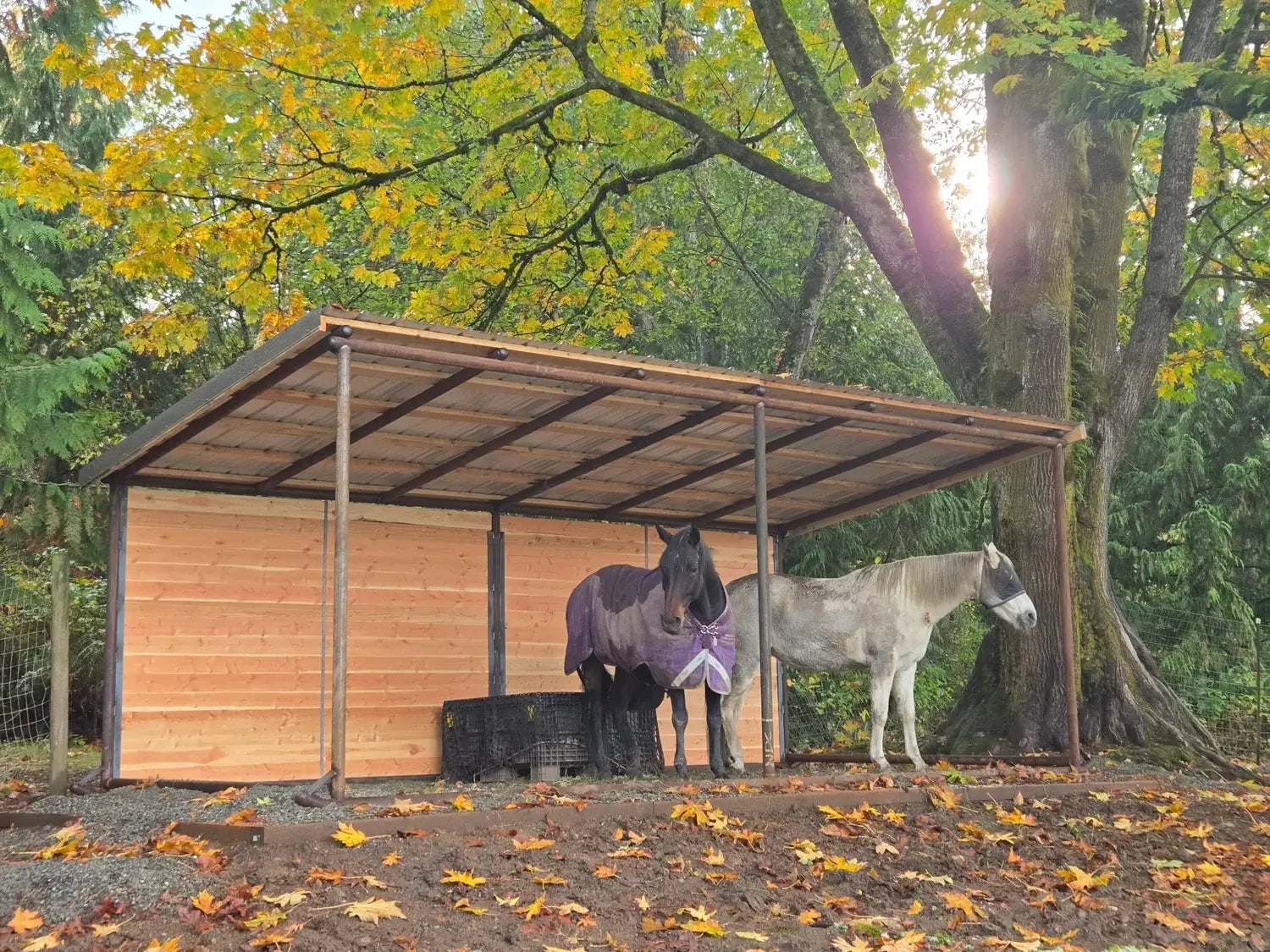
A sacrifice area — also called a dry lot, winter paddock, or heavy use area — is a designated space where horses can live outdoors without impacting pastures. It doesn't have to be large. It needs appropriate fencing, access to water and shelter, and stable footing.
The footing is where most sacrifice areas fail. Because you're concentrating all of your hoof traffic into a smaller space — especially during wet months — bare ground turns to mud quickly. Temporary fixes like wood chips or loose gravel break down or disappear within a season, creating the same cycle of repeated spending and repeated failure.
Lighthoof panels provide a permanent solution. The panels hold 3–4 inches of compacted angular crushed gravel in place over geotextile fabric — no excavation, no heavy equipment, and a stable, draining surface that doesn't break down under hoof traffic. It's a DIY-friendly project that makes your sacrifice area actually usable year-round instead of becoming the worst mud pit on the property.
For a complete guide to building a sacrifice area — including sizing, placement, footing, and maintenance — read our Sacrifice Area Guide.
Seasonal Quick-Reference Calendar
| Season | Pasture Action | Confinement Area |
|---|---|---|
| Spring | Don't turn out until ground is firm and grass is 6–8". Reintroduce horses gradually — limit grazing time. Monitor metabolic horses closely. Rotate between paddocks, never graze below 3". Apply compost 1/2"–1". Mow and drag after each grazing cycle. Check for weeds. | Use until pastures are ready. Keep horses here while ground is still soft, even if grass looks green. |
| Summer | Continue rotational grazing — maintain 3" minimum. Remove horses and feed hay if drought causes pastures to go dormant. Mow and drag after each cycle. Check for weeds. | Use whenever all paddocks are grazed down and none have recovered to 6–8". |
| Fall | Remove horses when grass reaches 3", soils become wet, or by November 1. Test soil. Apply compost 1/2"–1". This is the time to apply lime if needed. Allow plants to produce leaf growth for winter energy storage. | Transition horses to dry lots as pastures slow down. |
| Winter | No pasture access. Grasses are dormant, soil is wet and easily compacted. Plan next year's grazing strategy. | Full-time use. Horses should not have access to pastures during winter months. |
Adapted from the King Conservation District Pasture Management Overview.
Resources
These publications informed this guide and are excellent references for horse pasture management:
- King Conservation District — Pasture Management Overview (PDF fact sheet)
- Snohomish Conservation District — Confinement Areas for Horses (Sound Horsekeeping series)
- Penn State Extension — How to Make Rotational Grazing Work on Your Horse Farm
- University of Minnesota Extension — Managing Established Horse Pastures
- Oregon State Extension — Managing Small-Acreage Horse Farms
- Rutgers University — Establishing and Managing Horse Pastures
- University of Georgia Forage Extension — Horse Grazing Strategies
- University of Kentucky Equine Programs — Growing Horse Pastures From the Ground Up
- AQHA — Horse Pasture Management
Your local conservation district can provide free, one-on-one technical assistance with pasture management planning. Find yours at nacdnet.org.