

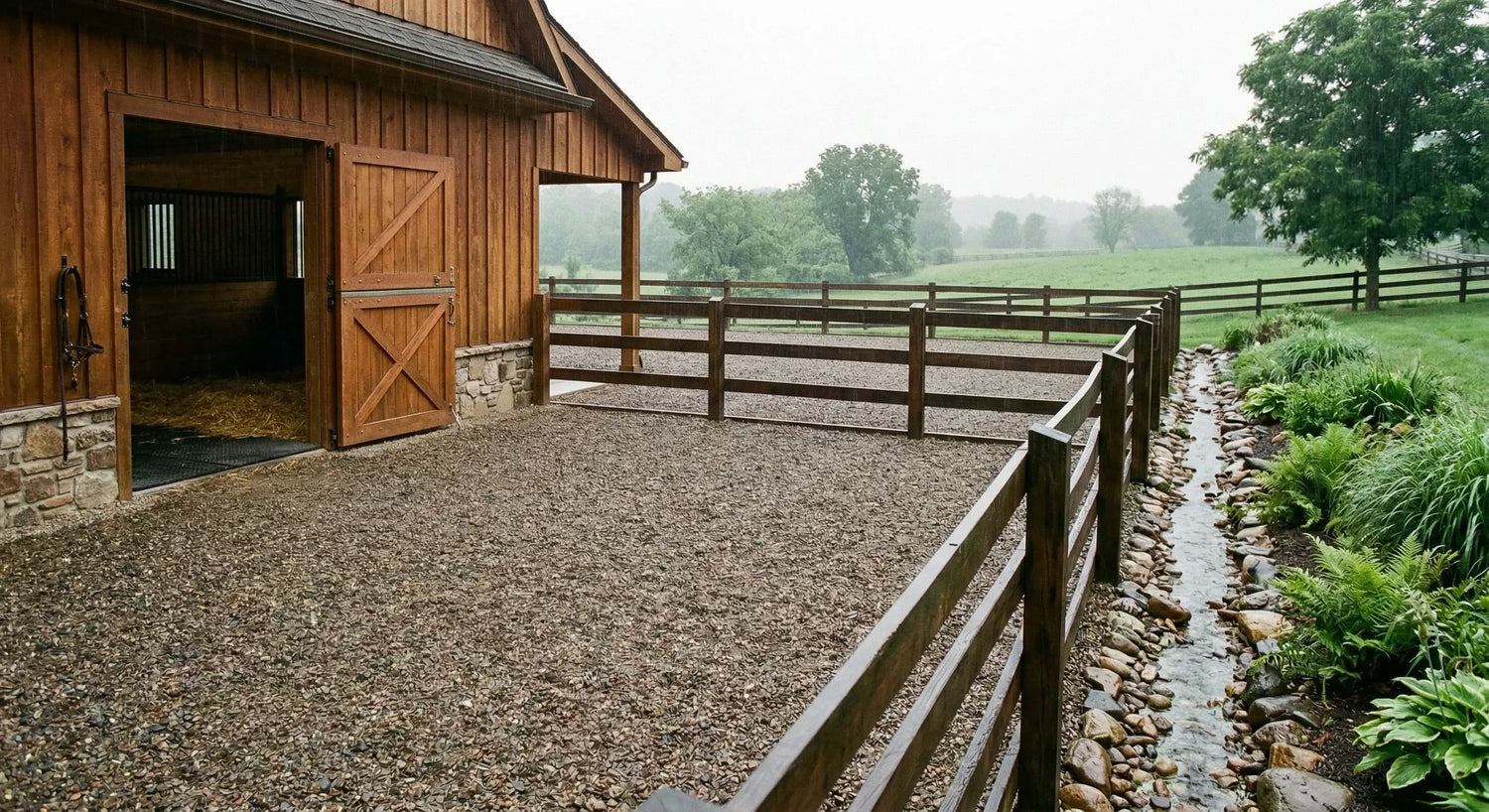
Drainage is the first thing most horse owners think about when they have a mud problem. It makes intuitive sense — if you could just get the water out of there, the mud would go away. Right?
Not exactly.
Drainage matters, but it's not the whole picture — and the most popular drainage solutions can actually make things worse when they're used in the wrong place. Horse paddocks present a unique set of challenges that driveways, gardens, and other surfaces don't face. A thousand-pound animal taking thousands of steps a day in a confined space creates forces that destroy conventional drainage systems from the inside out.
This guide covers how water actually behaves in a horse paddock, why the standard drainage advice often fails, and what to do instead. If you've been thinking about French drains, drain rock, or permeable footing as the answer to your mud problem, read this first.
Ground Stability Comes Before Drainage
This is the single most important concept in horse paddock mud management, and it's the one that most people get backwards.
A paddock that is graded for perfect drainage will still turn to mud if the ground surface is unstable. Here's why: when a horse steps onto wet, soft ground, the hoof acts like a plunger. It presses down into the soil, displacing water and earth sideways, then pulls back up — bringing a mix of water and soil to the surface. Repeat this thousands of times a day across every square foot of your paddock, and you have mud. Not because the water has nowhere to go, but because the ground can't hold itself together under the pressure.
Even on a slope. Even with good drainage. If the surface isn't stable, water moving across it will churn the ground into mud as it goes.
The goal isn't to eliminate water. It's to keep the ground firm regardless of how much water is present.
This is what Lighthoof does. The cells hold compacted gravel in place so that hoof traffic can't displace the footing — even when the ground is completely saturated. The surface stays firm, the water moves across it, and mud never forms.
Stability first. Drainage second. Get this order right and everything else falls into place.
For a deeper dive on this principle, read our article on why stability is more important than permeability.
The Guiding Principle of Drainage: Water Runs Downhill
Once your ground is stable, drainage becomes straightforward — because the only drainage strategy that reliably works inside a horse paddock is surface drainage.
Surface drainage means water flows across the top of the ground, following gravity, and exits the paddock at the lowest point. There's no pipe to clog. No buried system to crush. No void spaces to fill with manure. Just water moving downhill across a firm surface.
A slope of 2–3% is all you need. That's 2–3 feet of elevation change over 100 feet of distance — barely perceptible to you or your horse, but enough for water to move decisively in one direction.
How to Read Your Property's Water Flow
Before you install any footing or make any drainage changes, watch your property during a rainstorm. This is the single most useful thing you can do.
Walk the paddock (or watch from the barn) and note:
- Where does water enter? Is it falling directly from the sky, running off a roof, or flowing in from uphill?
- Where does it pool? These are your low spots — the places where water has no exit.
- Where does it exit? Follow the water to where it eventually leaves the paddock. This is the direction your drainage is already working.
- Where does it go that you don't want it? Into your barn? Against a fence line? Toward a neighbor's property?
These observations tell you exactly what needs to change. If your terrain already moves water in a good direction — away from structures and out of the paddock — your job is to protect that grade. If it's moving water toward your barn or trapping it in a low spot, you need to adjust the terrain before installing footing.
This matters because Lighthoof locks in the lay of the land. Once panels are installed, the terrain beneath them is protected from erosion and compaction. That's a major advantage — but it means any grading changes you want to make should happen before installation, not after.
Why "Through Drainage" Doesn't Work in Horse Paddocks
One of the most persistent myths in the horse world is the idea that mud can be solved by installing permeable footing — drain rock, pea gravel, or other materials with large void spaces — and letting water percolate down through the surface into the ground below.
It sounds logical. In practice, it fails every time in a horse environment, for three reasons:
1. Organic matter clogs the void spaces. Horse manure is a fine particulate material that sponges into the gaps between loose gravel almost immediately. Hair, hay scraps, and other organic debris do the same. Within a season, the drainage pathways that were supposed to let water pass through are filled with material that holds water instead. Once clogged, these pathways are impossible to clean without removing all the footing and starting over.
2. The subsoil won't accept the water. If your paddock was previously muddy, the ground beneath is already compacted from years of hoof traffic. Compacted soil has very low permeability — water can't infiltrate it at any meaningful rate. So even if your surface layer drains beautifully on day one, the water has nowhere to go once it reaches the compacted base. It pools between the layers and saturates back upward, creating a wet, unstable mess from below.
3. Materials that drain well don't compact well — and vice versa. Drain rock and pea gravel have large, uniform void spaces that allow water to pass through. But those same void spaces make the material inherently unstable. Round, uniform stones roll against each other under pressure. Horses' feet sink in, shift the material, and create an uneven, potentially dangerous surface. Conversely, materials that compact into a stable surface (like angular crushed rock with fines) have very little void space — which means limited percolation. You can't have it both ways.
The bottom line: don't invest in through-drainage for areas where horses have access. It's expensive, it fails, and it distracts from the approach that actually works — stable ground with surface drainage.
Gutters and Roof Runoff: The Easiest Win on Your Property
Before you dig a single drainage feature or order a yard of gravel, look up. If any structure with a roof is adjacent to your paddock — a barn, run-in shed, hay storage — the water falling off that roof may be your biggest source of paddock moisture.
The numbers are striking. A simple two-stall run-in shed in an area that receives 39 inches of annual rainfall sheds over 8,000 gallons of water per year. A full barn dumps many times that. All of it lands in a concentrated strip right at the drip line — often directly in front of stall doors, in the highest-traffic zone of the paddock.
Installing gutters and downspouts on every roofed structure and routing that water away from horse areas is the single highest-ROI drainage improvement most properties can make. It's not glamorous, but it removes thousands of gallons of water from the equation before you even start thinking about grading or footing.
Where to send the water:
- A vegetated buffer area (unused pasture, a stand of trees, or a planted rain garden)
- A rain barrel for non-potable use around the barn
- A dry well (a buried gravel pit that allows water to slowly infiltrate into the ground away from the paddock)
- A ditch or drainage easement, if available on your property
Where NOT to send it: back into the paddock, against a foundation, or toward a neighbor's property.
One more thing: protect your downspouts from horses. Horses will rub on, chew, and destroy exposed downspouts. Route them along fence lines outside the paddock, encase them in protective housing, or bury the outflow pipe below ground.
Swales: The Right Drainage Tool for Inside the Paddock
If you need to redirect water within your paddock — for example, intercepting runoff before it flows into your barn or shelter — a swale is the right tool.
A swale is simply a wide, shallow, open channel graded to move surface water in a specific direction. Think of it as a gentle, curving low spot in the terrain — not a ditch, not a trench, just a subtle undulation that gives water a path to follow.
Why Swales Work Where Other Drains Don't
Swales have three critical advantages in a horse paddock:
They're open and accessible. There's nothing to clog, nothing buried, nothing to crush. The drainage channel is right there on the surface where you can see it, maintain it, and confirm it's working during a rainstorm.
Horses walk through them without noticing. A properly graded swale is only a few inches deep and several feet wide. The grade is so gradual that horses step through it naturally. There's no tripping hazard, no awkward footing, no disruption to their movement.
They can be protected with Lighthoof. This is where the approach comes together. You grade the swale into your terrain before installing panels, then lay Lighthoof directly over the contour. Because Lighthoof is flexible, the panels follow the shape of the swale, filling it with stable gravel footing just like the rest of the paddock. The swale continues to function as a drainage channel — water flows through the low point — but the sides and bottom are permanently protected from erosion and won't collapse under hoof traffic.
Without stabilization, a swale inside a horse paddock would be destroyed within a single season. Hooves would break down the edges, collapse the channel, and churn it into a muddy trench. With Lighthoof over it, the swale holds its shape year after year.
A Common Scenario
Your barn sits at the downhill side of a gradually sloping paddock, and your stall doors are open for in-and-out access. Every time it rains, water flows straight down the hill and into your stalls.
The fix: use a shovel or light equipment to dig a wide, shallow swale uphill of the barn — running across the width of the paddock — to catch water as it moves downhill and redirect it around the barn to either side. This type of feature is sometimes called a curtain drain (though it's open, not buried). Install Lighthoof over the entire area, including through the swale, and the drainage feature is locked in, protected, and ready to work in every rainstorm.
We have a video showing exactly how this works and a 3-year follow-up showing the swale holding up under constant use and minimal maintenance: Watch the video here.
For more details on building swales with Lighthoof, read our guide to avoiding the two biggest paddock drainage misconceptions.
French Drains: Where They Work and Where They Don't
French drains are one of the most common drainage solutions recommended for residential and agricultural properties. They work by collecting water in a perforated pipe buried inside a gravel-filled trench, then carrying it to a discharge point downhill.
For many applications, they're effective. Inside a horse paddock, they're a problem.
Why French Drains Fail Inside Paddocks
Crushing. French drains rely on a perforated pipe surrounded by loose gravel in a trench. Horse hooves — and the farm equipment used to maintain paddocks — apply concentrated downward force directly above the pipe. Over time, this crushes the pipe, collapses the trench, and destroys the drain's ability to function. This is the same reason you don't see French drains installed under driveways or parking areas.
Clogging. Even if the pipe survives the physical pressure, the drain will clog. Horse manure, hair, hay, dust, and fine soil particles migrate into the gravel surrounding the pipe and fill the void spaces that allow water to enter. Once the drain is clogged, the only repair option is excavating the entire trench and replacing the system — an expensive, disruptive project that tears up your paddock.
Difficult to troubleshoot. Unlike a surface swale that you can inspect visually during a rainstorm, a buried French drain gives you no feedback. You can't see whether it's working, partially clogged, or completely failed until the symptoms (standing water, mud) are already severe.
Where French Drains Do Make Sense
French drains can be effective on a horse property when they're used outside the paddock, in areas that don't receive hoof traffic:
- Uphill of the paddock or barn, to intercept groundwater or surface runoff before it reaches the horse areas
- Along the uphill side of a driveway that channels water toward the barn
- Around the perimeter of a building foundation where water pools
In these locations, the drain isn't subject to hoof pressure or manure contamination, and it can function as designed for years with minimal maintenance.
The key distinction: a French drain outside the paddock is a useful supplement to a strong surface drainage plan inside the paddock. It's a nice-to-have, not a replacement. The surface drainage — grading, swales, and gutters — is what does the heavy lifting.
Putting It All Together: A Simple Drainage Plan
Paddock drainage doesn't require a hydrologist or an engineering degree. It requires understanding one principle (water runs downhill) and using the right tools in the right locations. Here's the sequence:
Step 1: Observe. Walk your property during rain. Map where water enters, pools, flows, and exits your paddock. Note any water flowing toward structures or getting trapped in low spots.
Step 2: Grade for surface flow. If water pools inside your paddock or flows toward your barn, use a shovel or light equipment to create gentle swales that redirect surface water out of the paddock or around structures. A few inches deep, several feet wide — subtle enough that horses walk through without noticing. This shaping needs to happen before you stabilize, because Lighthoof locks in the lay of the land.
Step 3: Stabilize the ground. Install Lighthoof panels over the graded terrain to lock in your drainage features, facilitate surface flow, and prevent mud. Lighthoof works even in very wet areas — the cells hold compacted gravel in place regardless of how saturated the ground is. Once the panels are in place, the swales are protected from erosion, the grade is protected from hoof compaction, and water moves across a firm surface instead of churning the ground into mud. This is what solves the mud problem.
Step 4: Manage roof runoff. Install gutters and downspouts on every structure adjacent to the paddock. Route the water to a vegetated area, rain barrel, or dry well — anywhere that isn't your paddock. With your ground already stabilized, this step keeps the whole area drier and reduces the volume of water your footing has to handle.
Step 5: Intercept uphill water if needed. If groundwater or surface runoff from uphill is feeding into your paddock, consider a French drain outside the paddock perimeter to catch it before it arrives. This is a supplemental measure, not a primary one — your stabilized footing is already handling the mud, and exterior drainage features like this simply improve overall conditions.
The order matters. Grade the terrain, stabilize the surface, then manage the water around it. Lighthoof handles mud even in the wettest conditions — the exterior drainage features keep the whole area drier and keeps the water away from your horses' hooves.
The Bottom Line
Paddock drainage isn't mysterious, and it doesn't require expensive buried systems. It requires getting the fundamentals right:
- Stabilize the ground first. Drainage without stability still can produce mud.
- Move water across the surface, not through it. Through-drainage fails in horse environments. Surface drainage is simple, reliable, and maintainable.
- Get the roof water out of the equation. Gutters are the cheapest, highest-impact improvement you can make.
- Use swales inside the paddock. Open, shallow, protected by Lighthoof — they can't clog, can't crush, and horses walk through them without a second thought.
- Save French drains for outside the paddock. They work well in areas without hoof traffic. Inside the paddock, they're expensive to install and even more expensive to fix when they fail.
If you'd like to go deeper on any of these topics, here are some related resources from our blog:
- Why Stability Is More Important than Permeability
- How to Avoid the Two Biggest Paddock Drainage Misconceptions
- How to Manage Water Runoff Issues Around Your Barn
- Paddock Drainage Swale Video — Including 3-Year Follow-Up
Have questions about your specific property? Send us photos or a description of your situation at mud@lighthoof.com or call 800-279-4716. We help horse owners plan drainage and footing projects every day.


Leave a comment
This site is protected by hCaptcha and the hCaptcha Privacy Policy and Terms of Service apply.