

You've decided to do something about the mud. You've done your research. And you've probably landed on the idea of laying fabric and gravel in your worst areas.
That's the right instinct. But the execution matters enormously — and this is where a lot of horse owners waste money and end up back at square one within a year.
Geotextile fabric is an essential part of a permanent mud solution. But fabric alone, even with gravel on top, can fail in a horse paddock. This guide explains what fabric actually does, which type to use, why it needs to be part of a system rather than the whole system, and how to install it properly.
What Geotextile Fabric Actually Does
Fabric has one job: separation.
It keeps your gravel from sinking into the mud below. That's it. That's the whole purpose.
Without a separation layer, gravel placed on soft ground gets pushed down by hoof pressure and disappears into the soil. Sometimes it happens immediately — especially if the mud is deep. Sometimes it takes a season. Either way, you lose your investment.
There's an old saying in road building: "When you spread 50 pounds of stone over 50 pounds of mud, you end up with 100 pounds of mud." The heavier material simply sinks into the softer material underneath. A layer of fabric between the two prevents that mixing from happening.
So fabric is essential. But here's the critical distinction: fabric separates. It does not stabilize. And in a horse paddock, you need both.
Why Fabric Alone Fails in Horse Paddocks
The most common mistake we see is someone laying fabric, spreading a few inches of loose gravel on top, and hoping for the best. It seems like a reasonable, budget-friendly approach. In practice, it fails every time in a horse environment.
Here's what actually happens:
Hooves punch through
Horses concentrate significant weight on small hooves. Each step plunges downward into the footing, pushing the gravel and the fabric into the soft ground below. The fabric doesn't stretch to accommodate this — instead, the edges pull inward, shifting the entire sheet. Thousands of steps per day. Thousands of tiny displacements.
Gravel disappears into the holes
Every hoof-shaped depression needs to be filled with something, and the surrounding gravel slides in to do it. Your footing material is steadily migrating from the surface into the depressions below. You're losing gravel with every step your horse takes and exposing bare fabric.
Edges recede from the fence line
As the fabric bunches and shifts inward, it drags gravel away from the perimeter of your installation. This exposes bare mud along the fence line — which is a high-traffic zone for most horses. You're right back to mud in the areas that matter most.
Exposed fabric becomes a hazard
Once fabric edges are exposed, wrinkles and tears create tripping and tangling risks. Horses can catch a hoof in bunched-up fabric. Some horses enjoy pulling at it, accelerating the destruction and exposing mud underneath.
You're starting over within a year
What seemed like an inexpensive solution becomes an expensive annual cycle: replacing fabric (and it is soooo hard to get out of the ground), re-graveling, and doing the same project over again every season.
The core problem is that fabric provides separation but not structure. In a horse paddock, where small hooves deliver concentrated force thousands of times a day, you need something that holds the footing in place — not just a liner underneath it.
For a deeper dive on this topic, read our original article on why fabric alone isn't a good mud management solution.
Fabric Is a Layer, Not a Solution
Fabric keeps gravel from mixing with the mud. That's its job, and it does it well. But fabric can't keep gravel from shifting laterally, being displaced by hooves, or losing its compaction under daily traffic. That requires structure.
This is what Lighthoof panels provide. The 3-inch-deep cells confine the gravel, prevent lateral movement, and maintain a firm, compacted surface no matter how many steps your horse takes. The gravel can't spread, can't shift, and can't be churned out of position.
The system works because each layer has a specific job:
- Fabric separates your gravel from the mud below — preventing your investment from sinking
- Lighthoof structures and confines the gravel — preventing displacement from hoof traffic, protecting your fabric, and holding it in place
- Gravel compacts into the cells — creating a firm, draining surface
None of these layers work as well alone as they do together.
Without fabric, gravel sinks into the mud. Without Lighthoof, gravel shifts, spreads, and needs constant replenishment. Without the right gravel, nothing compacts properly.
Together, they create a permanent surface. This is why we sell Lighthoof panels bundled with geotextile fabric — because they're designed to work as a system, and bundling them makes it easy and saves you money!
The Right Fabric for the Job
Now that we've had a look at a system that works, here's what to look for when choosing your fabric.
What we recommend: 6 oz non-woven needle-punched geotextile
This is what we sell and use on our own installations. It looks like a heavy black felt, and it has several properties that make it ideal for this application:
- Durable. Thick enough to resist tearing during installation and under long-term use.
- Not slippery. You can walk on it comfortably while installing your panels — no ice-rink effect.
- Water permeable. Allows moisture to filter through into the ground rather than pooling on top. This matters because trapped water under your installation can create problems over time.
- Comes in wide sheets. Covers ground efficiently with fewer overlapping rows, which means less fuss during installation.
- Easy to work with. Cuts cleanly, lays flat, and doesn't catch on things.
Geotextile fabric thickness is measured by weight — ounces per square yard. At 6 oz, you get a fabric that's durable enough to handle the job without being overkill. It's the sweet spot.
You can purchase fabric bundled with Lighthoof panels or separately from Lighthoof. It's also available from landscape supply companies if you prefer to source locally.
What about other fabric types?
Lighthoof can tolerate a wide range of fabrics. The most important thing is that gravel doesn't sink directly into the mud during installation — so almost anything is better than nothing. But some products cause more headaches than others:
Black plastic sheeting or plastic weed barrier. Slippery, tears easily, and doesn't let any water through. Moisture pools on top instead of filtering down, which can create problems under and around your installation.
Woven geotextile. Heavy-duty and strong, but tends to be slippery. The woven fibers catch on things and can be difficult to cut cleanly.
Thin lightweight weed barrier (the small rolls from the hardware store). Can work in a pinch, but the narrow roll width means lots of overlapping rows. And the lightweight material catches any breeze — during installation, you'll find yourself chasing sheets across the pasture and re-laying them before you can stretch your panels.
The bottom line: if you can get 6 oz non-woven geotextile, use it. If you can't, use whatever fabric you have access to — just get something between your gravel and the ground. Something is always better than nothing.
How to Install Fabric Properly
Installation is straightforward. A few details make the difference between a fabric layer that performs for years and one that causes problems.
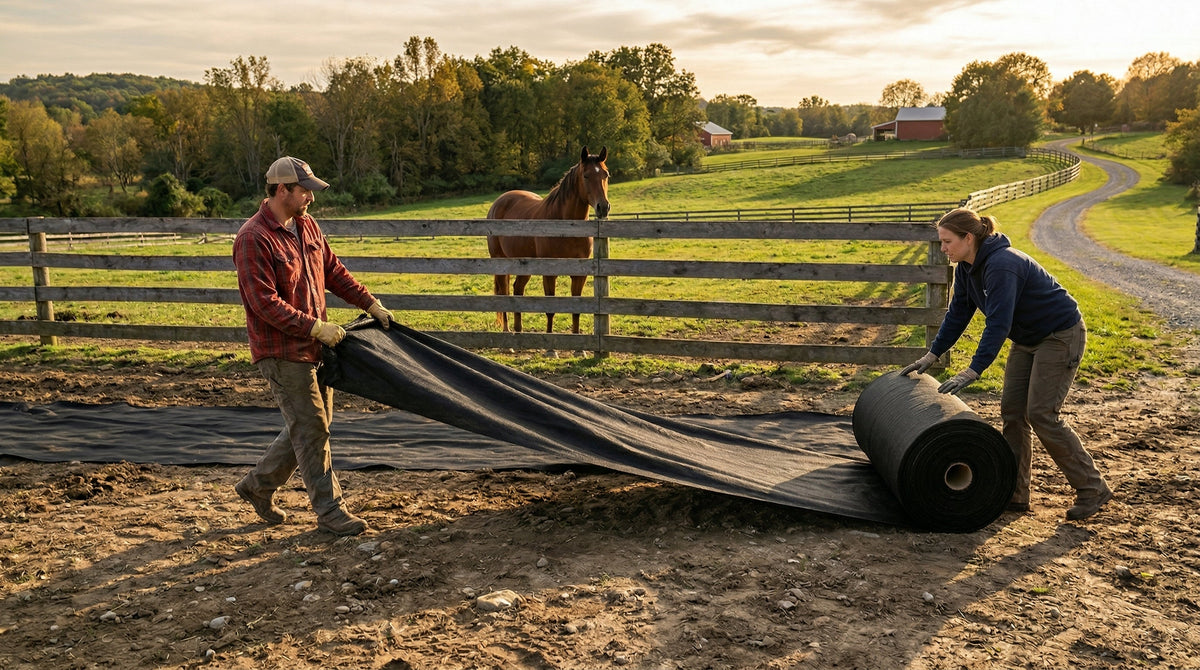
Roll out over existing ground. You do NOT need to remove mud or excavate. Fabric goes directly on top of whatever is there.
Overlap edges by at least 18 inches. This prevents gaps where soil can migrate upward through the seam. Don't skimp on the overlap — fabric is cheap compared to gravel, and a generous overlap costs almost nothing.
Pull tight and smooth out wrinkles. Before placing Lighthoof panels on top, make sure the fabric is lying flat with no bunching. Wrinkles under the panels can create uneven spots in your finished surface.
Extend to the full perimeter. Don't leave exposed ground at the edges of your installation. Fabric should cover the entire area that will receive panels and gravel, all the way to your edge border lumber.
For the complete step-by-step process — fabric, panels, gravel, and edge protection — see the Lighthoof Installation Guide.
Protecting Your Gravel Investment
This is really what the fabric conversation comes down to: protecting your gravel.
Gravel is expensive. Every cubic yard that sinks into the mud is money gone. People who skip fabric and Lighthoof and just dump loose gravel on their paddock often need to re-gravel every year — and they need far more gravel per application because so much of it is lost to the ground immediately.
With fabric and Lighthoof, you need just 3–4 inches of gravel for a permanent surface. Without them, extension services recommend 8 or more inches of gravel for an unstabilized installation — and even at that depth, you'll be adding material annually as it shifts and sinks.
The fabric costs a fraction of what the gravel costs. The Lighthoof panels pay for themselves in reduced gravel usage alone. Every layer in this system exists to protect your investment in the layer above it.
For detailed guidance on choosing the right gravel, read our Complete Gravel Guide.
The Bottom Line
Geotextile fabric is essential for any mud management project in a horse paddock. It prevents your gravel from disappearing into the ground — which is exactly what happens when you skip it.
But fabric alone isn't a mud solution. It's a separation layer. Without structure on top to hold the footing in place, you'll be re-doing the project within a year.
If you're about to lay fabric and gravel in your paddock, you're one step away from a permanent solution instead of a temporary one. Add Lighthoof panels between the fabric and the gravel, and you won't be doing this project again next year — or the year after that.
Related resources:
- Why Fabric Alone Fails in Horse Paddocks — Our original deep dive on this topic
- Lighthoof Installation Guide — Complete step-by-step with video
- Complete Gravel Guide — How to choose the right gravel
- 6 oz Non-Woven Geotextile Fabric — Available from Lighthoof
- Lighthoof Panels + Fabric Bundles — Panels and fabric together at a discount
Questions? Contact us at mud@lighthoof.com or call 800-279-4716. We've been helping horse owners get this right for over 14 years.

Leave a comment
This site is protected by hCaptcha and the hCaptcha Privacy Policy and Terms of Service apply.